
Table of contents
- 1.What to look at first
- 2.Which pools the law covers
- 3.The child-resistant barrier
- 4.Fence measurements
- 5.Non-climbable zone, doors and spa pools
- 6.Gates
- 7.Warning signs
- 8.Australian Standards
- 9.Older pools and exemptions
- 10.Registration
- 11.Inspections and certificates
- 12.Selling and leasing
- 13.Building a new pool
- 14.Next step
- 15.Sources
- 16.Frequently asked questions
What to look at first
In NSW, under the pool owner obligations and the Swimming Pools Act 1992, a pool or spa needs a child-resistant barrier, a gate, registration on the NSW Swimming Pool Register, and a certificate after an inspection.
Start with the barrier that surrounds the pool, the gate in that barrier, whether the pool is on the register, and whether a certificate of compliance is in place.
The owner may ask the local authority or a registered certifier to inspect. Local councils and registered swimming pool inspectors inspect a pool and issue a certificate of compliance when the barrier meets the requirements. Questions about a particular property go to the council or a registered certifier.
- The law covers a child-resistant barrier that separates the pool from the home and from places next to the property.
- The gate is part of that barrier. It should swing away from the pool, close by itself and latch when it shuts.
- Registration and inspection are separate. Registering a pool does not mean it meets compliance requirements.
- A certificate of compliance follows an inspection by the local council or a registered certifier.
- The local council or a registered certifier is who to ask about a particular property.
Which pools the law covers
Section 4 of the Swimming Pools Act 1992 applies to swimming pools, outdoor and indoor, that are situated or proposed on premises where a residential building, a moveable dwelling or tourist and visitor accommodation is located. The Act does not apply to pools on premises occupied by the Crown or by a public authority.
In NSW, the Act applies to swimming pools and spa pools on sites with a residential building, a movable dwelling or tourist and visitor accommodation. The law applies to an excavation, structure or vessel that can be filled to a depth greater than 30cm and that is used, designed, manufactured or adapted for swimming, wading, paddling or any other human aquatic activity.
Portable pools that can hold more than 30cm of water are subject to the same fencing and safety requirements as permanent pools, including a child-resistant barrier complying with Australian Standard AS1926. For pools with a capacity over 2,000L, development approval may also be required, and the local council should be contacted for specific requirements.
On strata or community scheme common property, all lot owners jointly own the pool or spa, and the owners corporation is responsible for compliance with the Act.
The child-resistant barrier
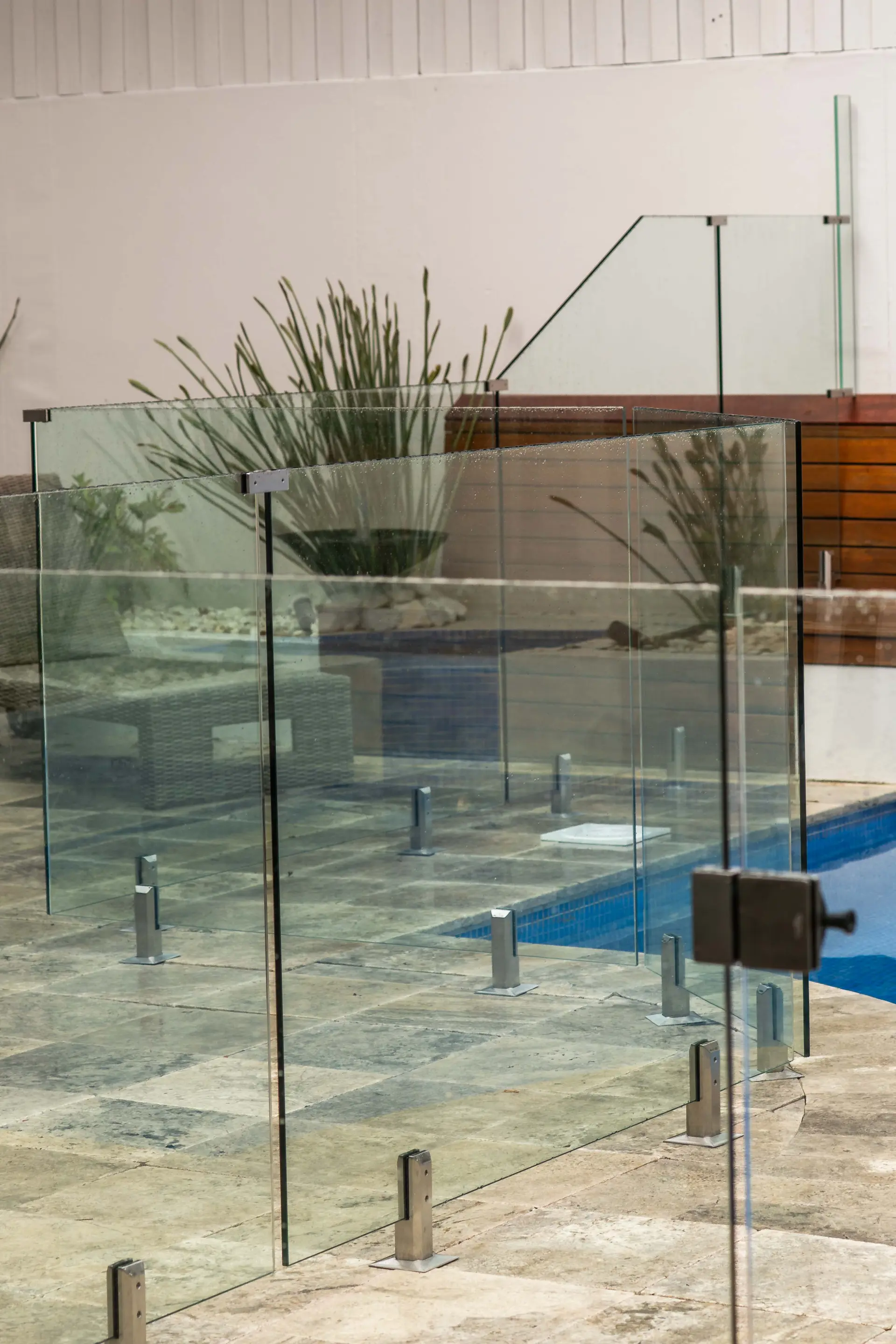
Section 7 of the Swimming Pools Act 1992 requires the owner of premises with an outdoor swimming pool to ensure the pool is at all times surrounded by a child-resistant barrier. The barrier must separate the pool from any residential building on the premises and from any place, public or private, adjoining the premises. It must be designed, constructed, installed and maintained in accordance with the standards prescribed by the regulations.
Section 15 requires the occupier, so long as the pool exists, to maintain that barrier in existence and in a good state of repair as an effective and safe child-resistant barrier. Section 16 requires the occupier to keep all doors and gates that provide access to the pool securely closed at all times when they are not in actual use.
Owners must at all times surround the pool with a child-resistant safety barrier that separates it from any residential building and from any place adjoining the property, keep closed the doors and gates that provide access, and keep the fence designed, constructed, installed and maintained to the relevant Australian Standards.
Fence measurements
The measurements below are the key pool fence measurements in NSW. Some older pools are treated differently. See Older pools and exemptions.
- A pool fence must be at least 1.2m high, measured from the finished ground level.
- The fence must not leave a gap at the bottom bigger than 10cm from the finished ground level.
- If a boundary fence is part of the pool fence, the barrier must be 1.8m high.
- There must not be gaps of more than 10cm between any vertical bars.
- If the fence contains horizontal climbable bars, these must be spaced at least 90cm apart.
- Perforated or mesh barriers must have holes no greater than 13mm for fence heights of 1.2m.
- Perforated or mesh barriers of 1.8m height with holes greater than 13mm must not exceed 100mm.
- The pool fence must be well maintained and in good working order.
Non-climbable zone, doors and spa pools
Pool owners must maintain a non-climbable zone around the pool. Trees, shrubs and other objects, including a barbeque, pot plants, toys, ladders and chairs, must not be within the 90cm non-climbable zone. That zone is measured in an arc from the top of the pool fence towards the ground. The space extending 30cm inside the pool area should be clear of footholds or handholds. Horizontal climbable bars must be spaced at least 90cm apart.
Older swimming pools might include doors or windows as part of the barrier. This is no longer allowed.
On spa pools, some spas may use a securely fastened, child-resistant structure, such as a lid, grille or mesh, to prevent access when the spa is not in use. This exemption can depend on the size or function of the spa, and some larger swim spas may require a fence. Under section 20 of the Swimming Pools Act 1992, a spa pool is not required to be surrounded by a child-resistant barrier so long as access to the water is restricted, in accordance with the standards prescribed by the regulations, at all times when the spa is not in actual use.
Gates
Check a pool gate against all of the points below. Section 16 of the Swimming Pools Act 1992 requires doors and gates that provide access to the pool to be kept securely closed when they are not in actual use.
- The gate is never propped open and is always kept shut.
- The gate swings outwards, away from the pool area. If it does not, the gate must be re-hung so that it does.
- The gate shuts automatically from any open position, without having to be forcibly closed.
- The gate automatically locks, or self-latches, when it closes.
Warning signs
Section 17 of the Swimming Pools Act 1992 requires the occupier to keep a sign, erected in accordance with the regulations and bearing the notice required by the regulations, in a prominent position in the immediate vicinity of the pool.
The law requires a cardiopulmonary resuscitation (CPR) sign displayed near the pool, including portable pools. The sign must be in good condition and easily readable from 3m away. New CPR signs came into effect on 1 September 2019. All new pools must use the updated signage. Owners of existing pools are not required to update the signage unless the pool barrier is substantially altered or rebuilt.
Australian Standards
As at 16 March 2026, the relevant versions of AS1926 are dated 1986, 2007 and 2012. The requirements vary with when the pool was built, where it is located, and whether it has since been modified. Three standards may apply in NSW:
AS 1926.1:2024 is a revised edition that specifies design, construction, component and testing requirements intended to restrict access by children to swimming pools and spas. The 2024 edition is sold through the Standards Australia Store. For a particular pool, the edition follows the Act and the Regulation.
- AS 1926-1986 may apply to pools constructed prior to 30 August 2008.
- AS 1926.1-2007 may apply to pools constructed between 1 September 2008 and 30 April 2013.
- AS1926.1-2012 applies to pools constructed after 1 May 2013.
Older pools and exemptions
Section 8 of the Swimming Pools Act 1992 covers pools whose construction or installation commenced before 1 August 1990, and pools whose construction or installation commenced before 1 July 2010 on premises of less than 230 square metres. For those pools, the child-resistant barrier is not required to separate the pool from a residential building on the premises, so long as access from the building is at all times restricted in accordance with the standards prescribed by the regulations. The section ceases to apply if a barrier is erected between the pool and a residential building.
Section 9 covers pools whose construction or installation commenced before 1 July 2010 on premises of 2 hectares or more. Those pools are not required to be surrounded by a child-resistant barrier, so long as access from any residential building is restricted in accordance with the standards prescribed by the regulations. A structure such as a garage or shed that is ancillary and not itself used for residential purposes is not treated as the residential building. The section ceases to apply if a barrier is erected between the pool and a residential building.
Section 10 is the waterfront exemption for pools whose construction or installation commenced before 1 July 2010, where the premises have frontage to a large body of water. The pool is not required to be surrounded by a child-resistant barrier so long as access from any residential building is restricted in accordance with the prescribed standards. The same limits on ancillary structures, and the same rule if a barrier is later erected, apply as in section 9.
Section 22 allows the local authority, on an application by the owner, to exempt a pool from all or any of the barrier requirements in that Part if it is satisfied that compliance is impracticable or unreasonable in the particular case, or that an alternative is no less effective. For appeal proceedings, the local authority is taken to have refused the application if it has not finally determined it within 6 weeks after the application was made.
Registration
Part 3A of the Swimming Pools Act 1992 creates a Register of Swimming Pools, kept by the Secretary. Section 30B requires the owner to ensure that the information prescribed by the regulations is entered on the Register. The owner complies by giving that information to the Secretary, or by giving it to a local authority and paying any fee the local authority requires, up to any maximum the regulations prescribe. The pool is registered when that information is entered.
Every swimming pool and spa owner must register the pool or spa. A local council can register it for a small fee. Pools are registered against the property address, not the name of the owner. A first registration needs the address and basic property details. Property owners do not need an account and do not need to provide personal details.
Swimming pools and spas must be registered in NSW. Owners can use the online registration form on the NSW Swimming Pool Register, and a local council can register a pool for a fee.
Registering a pool does not mean it meets compliance requirements. Compliance is assessed separately, through an inspection by the local council or a registered certifier.
Inspections and certificates
Section 22A of the Swimming Pools Act 1992 defines a registered certifier as a person registered under the Building and Development Certifiers Act 2018, acting in respect of matters to which the registration applies. Under section 22C, the owner may ask the local authority or a registered certifier to inspect the pool. A written request to the local authority that states the inspection is required for the sale or lease of the premises must be carried out within a reasonable time.
Under section 22D, a certificate of compliance requires that the pool is registered under Part 3A and that it complies with the barrier part of the Act. A local authority or registered certifier who has inspected the pool and is satisfied of those requirements must issue the certificate. The certificate remains valid for 3 years from the date it is issued, and ceases to be valid if a direction is issued under section 23 for that pool.
Section 22B requires each local authority to develop and adopt a plan for inspecting swimming pools in its area. That plan must provide for inspection, at least once every 3 years, of any swimming pool on premises with tourist and visitor accommodation or with more than 2 dwellings. The plan is not to require inspection of a pool that already has a valid certificate of compliance or a relevant occupation certificate.
Local councils have enforcement powers over barrier compliance. Councils inspect pools associated with moveable dwellings and tourist and visitor accommodation at 3-year intervals, inspect at the request of an owner before a sale or lease, and issue a certificate of compliance or non-compliance after an inspection.
The Building Commission NSW registers professionals to inspect and certify private swimming pools. A registered swimming pool inspector, at the request of an owner, inspects a pool or spa before a sale or lease, issues a certificate of compliance or non-compliance, and gives written notice to the owner and the council when a pool does not comply.
Under the National Construction Code, from 1 September 2018 the performance requirements of the Building Code of Australia for swimming pool barriers can be met by a performance solution or a deemed-to-satisfy solution. For a pool with a performance solution, a certifier registered as a building surveyor unrestricted, or as a building surveyor restricted for all classes of building, can inspect, as can the local council. A certifier registered as a building surveyor restricted to class 1 and 10 buildings can inspect only if the performance solution relates to clause H2P4 of Vol.2 of the Building Code of Australia. A certifier registered as a swimming pool inspector cannot certify that pool.
Some certifiers may do minor repairs, up to $1,000 including materials and labour, so they can issue a certificate of compliance. To do that work they must hold an endorsed contractor licence or a qualified supervisor certificate under the Home Building Act, authorising them to build a swimming pool or to do structural landscaping. The pool owner is free to hire another tradesperson to do the work.
A certificate of compliance is valid for 3 years. Councils and registered swimming pool inspectors can inspect the barrier and will issue a certificate of compliance if it meets the requirements. Owners should contact the council or a private certifier early, to allow time to organise an inspection before renting or selling.
Selling and leasing
An owner who is selling a property with a pool or spa must include, in the contract for sale, a registration certificate from the Swimming Pool Register and one of the following: a relevant occupation certificate issued within the last 3 years, a valid swimming pool certificate of compliance, or a certificate of non-compliance.
If one of those is not included, the purchaser may rescind the contract within 14 days of exchange, unless settlement has already occurred. If a certificate of non-compliance is attached, the purchaser takes on the obligation to obtain a certificate of compliance, and has 90 days from settlement to rectify the defects listed and obtain that certificate, unless the certificate of non-compliance states that the pool poses a significant risk to public safety. This sale rule does not apply to a lot in a strata scheme or a community scheme with more than 2 lots, or to an off-the-plan sales contract.
For a residential tenancy, the landlord or real estate agent must give the tenant a copy of the certificate of compliance or occupation certificate. A certificate of non-compliance cannot be used to rent the property. This does not apply to a lot in a strata scheme or community scheme with more than two lots. Concerns about the actions of a real estate agent can be taken to NSW Fair Trading.
To rent a property with a swimming pool, the landlord or agent must comply with the laws and give tenants a copy of valid certificates. Landlords must meet the standards in the Swimming Pools Act 1992, and this requires most pools to be surrounded by a fence that separates the pool from the house. When the tenant signs the tenancy agreement, the landlord or agent must provide a copy of the valid certificate of compliance or occupation certificate issued in the last 3 years. That requirement does not apply if the property is in a strata or community scheme with more than 2 lots.
Building a new pool
A person building or installing a new pool must talk to the local council about approval, or check the supplier details for a spa or portable pool. The work must use a builder licensed by the Building Commission NSW. A principal certifier, council or private, must be appointed. Child-resistant temporary fencing must be installed around the pool area while it is under construction. The permanent fence must comply with the Building Code of Australia. The principal certifier inspects once the permanent fence is installed. The pool must not be used until an occupation certificate has been issued, and signage must say the pool is not to be used until that certificate is issued.
Pools under construction must display a notice in a prominent position near the pool. The notice must read that this swimming pool is not to be occupied or used. It must stay in place at all times during construction, and it is removed only once an occupation certificate has been issued, or once a certificate of compliance has been issued. Failure to comply can lead to a penalty notice under the Swimming Pools Regulation 2018. Ask the local council or a private registered certifier who can approve the plans, and check the legal requirements for a child-resistant barrier.
Next step
For the glass pool fencing service, use the service page. To ask about a property, use the contact page and request a quote.
Sources
The sources below include the Swimming Pools Regulation 2018, linked with the Act.
- NSW Government, Owning a pool or spa: your obligations. Which pools are covered, fence measurements, the non-climbable zone, gates, CPR signage, standard editions, registration, inspections, sale and lease.
- NSW Government, Building a pool: your rights and obligations. Construction notice, occupation certificate, and a penalty notice under the Swimming Pools Regulation 2018.
- Swimming Pools Act 1992 No 49, current version on the NSW legislation website. Sections cited above include 4, 7, 8, 9, 10, 15, 16, 17, 20, 22, 22A to 22D and 30A to 30B.
- Swimming Pools Regulation 2018, current in-force version on the NSW legislation website, together with the Swimming Pools Act 1992.
- NSW Swimming Pool Register. Pools and spas must be registered, online or through the local council for a fee.
- NSW Fair Trading, Swimming pools and spas in a rental property. Certificate to be given when a tenancy agreement is signed.
- NSW Fair Trading. The agency that publishes the rental-property page.
- Standards Australia news, 3 September 2024, updated 7 January 2025. What AS 1926.1:2024 covers. The edition for a particular pool follows the construction date and any later change to the barrier.
- Standards Australia Store. AS 1926.1:2024, Swimming pool safety, Part 1: Safety barriers for swimming pools.